You love each other. That part isn’t in question.
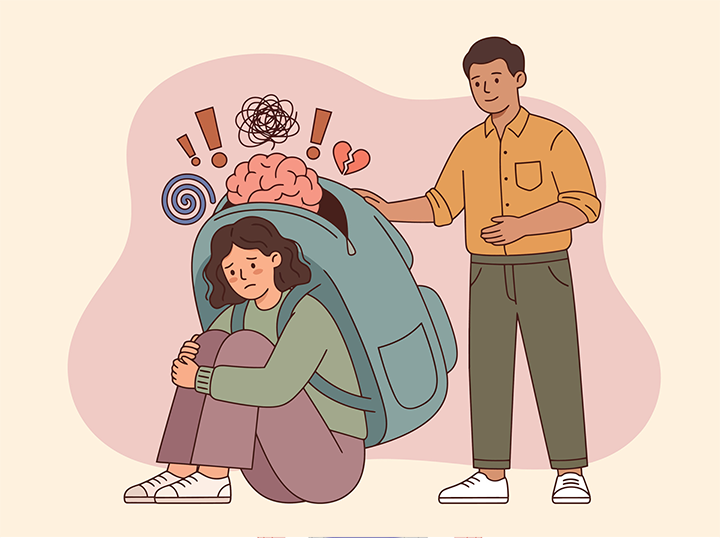
But something is off. One of you lies awake running through worst-case scenarios while the other falls asleep in minutes. One of you needs to talk through every worry before you can move on; the other can’t understand why you can’t just “let it go.” One of you cancels plans, avoids certain situations, or needs reassurance that everything is okay, a lot. The other is patient, until they’re not.
If this sounds familiar, you’re not alone. When one partner has anxiety and the other doesn’t, it creates a very specific kind of relationship strain, one that rarely gets talked about directly, and one that can quietly erode even genuinely loving partnerships if it goes unaddressed.
As a therapist who works with both individuals and couples in Westfield, NJ, I see this dynamic often. And the good news is: it’s very workable, when both partners understand what’s actually happening.
What the Research Says
This isn’t just anecdotal. There’s a meaningful body of research on how anxiety affects couples.
A study published in the Journal of Abnormal Psychology followed couples in which one partner had an anxiety disorder and found significant associations between the anxious partner’s daily anxiety levels and both partners’ perceptions of relationship quality. In other words, on the days the anxious partner felt worse, both partners rated the relationship as worse, regardless of whether anything specific had happened between them (Zaider, Heimberg, & Iida, 2010).
Research from the Anxiety and Depression Association of America (ADAA) found that people with generalized anxiety disorder were two times more likely to experience regular relationship problems and three times more likely to avoid intimacy with their partner than those without an anxiety disorder.
And a study in Psychiatry Research examining 85 couples found that the presence of an anxiety disorder in even one partner negatively affected the overall quality of the relationship, with couples where the female partner had anxiety being particularly vulnerable to relationship distress (Kasalova et al., 2012).
This isn’t about blame. It’s just the reality of what anxiety does to the relational system when it goes unaddressed.
The Anxious Partner’s Experience
If you’re the one with anxiety, you probably already know the relationship is affected. What you may not fully see is how much energy you spend managing your partner’s reaction to your anxiety, on top of the anxiety itself.
You worry about being “too much.” You apologize for needing reassurance. You try to hide how bad the spiral got last night because you don’t want to seem weak, or needy, or broken. And then you feel alone, not because your partner isn’t there, but because the part of you that’s really struggling feels like it has to stay hidden.
Anxiety also has a way of pulling your focus inward. When your nervous system is on high alert, it’s genuinely harder to be emotionally present and available to your partner. Research confirms this: when anxious partners are preoccupied with their symptoms, non-anxious partners often report feeling less supported and less connected, even when no conflict has occurred (Craske et al., 1989, as cited in Zaider et al., 2010).
This isn’t a character flaw. It’s what anxiety does to the nervous system. But understanding it can open a very different conversation with your partner.
The Non-Anxious Partner’s Experience
If you’re the partner without anxiety, your experience deserves just as much attention, and it often gets overlooked entirely.
You love this person. You want to help. So you do. You answer the reassurance questions. You adjust plans when they’re overwhelmed. You pick up the slack on the days they can’t. You tell yourself it’s fine, because they can’t help it, because you’re the “stable one.”
But over time, something starts to build. Fatigue. Frustration. Maybe resentment, and then guilt for feeling resentful about something that isn’t your partner’s fault. You might start to feel less like a partner and more like a caretaker. You may find yourself walking on eggshells, calibrating your words and actions to manage their anxiety before it spikes.
Research has a name for this pattern: anxiety accommodation. It’s what happens when the non-anxious partner consistently adjusts their behavior to help the anxious partner avoid distress. And while it comes from a loving place, research from the University of North Carolina shows that anxiety accommodation can actually maintain and worsen anxiety over time, while also increasing stress and burnout in the accommodating partner (Boeding et al., 2013).
In other words: trying to protect your partner from their anxiety can inadvertently keep them stuck in it. And exhaust you in the process.
The Cycle That Keeps Couples Stuck
Here’s how the pattern often unfolds, over and over:
The anxious partner feels distress and seeks reassurance or avoids a situation. The non-anxious partner provides reassurance or accommodates the avoidance because it helps in the moment. The anxious partner feels temporary relief, but the anxiety comes back, often stronger, because the avoidance confirmed that the situation was worth fearing. The non-anxious partner feels the weight of being the emotional anchor and starts to quietly withdraw or grow frustrated. The anxious partner senses the withdrawal and feels more anxious. And the cycle continues.
Neither person is doing anything wrong, exactly. They’re both trying to cope. But the pattern itself is working against both of them.
What Actually Helps
For the anxious partner: The most important thing you can do for your relationship is get support for your anxiety, not just for yourself, but because untreated anxiety has a real cost on the people you love. Therapy, particularly cognitive behavioral approaches to anxiety, can help you build tolerance for discomfort so you rely less on reassurance and avoidance to get through hard moments.
For the non-anxious partner: Your needs matter too, and naming them isn’t selfish. The ADAA recommends that partners of anxious individuals maintain their own interests, support systems, and boundaries, not to abandon their partner, but to avoid the burnout that comes from making someone else’s anxiety the center of your shared life.
For both of you: Talk about the anxiety directly, not in the middle of a spiral, but in a calm moment. What does the anxious partner actually need? What is and isn’t sustainable for the non-anxious partner? Where is the line between support and accommodation?
These are hard conversations to have alone. Couples therapy can be a powerful space to have them, with someone who understands both the neuroscience of anxiety and the dynamics of close relationships. The goal isn’t for one partner to fix the other. It’s to build a shared understanding of what’s happening, and a new way of navigating it together.
You Can Find Your Way Back to Each Other
Anxiety doesn’t have to define your relationship. Couples navigate this successfully all the time, not by eliminating anxiety, but by building the tools and understanding to stop letting it run the show.
If you’re in the Westfield, NJ area and this resonates, whether you’re the anxious partner, the non-anxious partner, or honestly a bit of both — I’d love to talk. Reach out here or call me at (908) 232-4044.
If you’d like to read more about anxiety, check out these articles, People Pleasing is Anxiety in Disguise, Why Avoidance Makes Anxiety Worse or What is the Difference Between Anxiety and Intuition
By Jill Giuliano, LCSW | Anxiety and Couples Therapy in Westfield, NJ
References
- Anxiety and Depression Association of America (ADAA). Spouse or Partner. adaa.org
- Boeding, S. E., Paprocki, C. M., Baucom, D. H., Abramowitz, J. S., Wheaton, M. G., Fabricant, L. E., & Fischer, M. S. (2013). Let me check that for you: Symptom accommodation in romantic partners of adults with obsessive–compulsive disorder. Behaviour Research and Therapy, 51(6), 316–322. Via Psychology Today
- Kasalova, P., Prasko, J., et al. (2012). Anxiety disorders in intimate partners and the quality of their relationship. Psychiatry Research. ScienceDirect
- Zaider, T. I., Heimberg, R. G., & Iida, M. (2010). Anxiety disorders and intimate relationships: A study of daily processes in couples. Journal of Abnormal Psychology, 119(1), 163–173. PubMed | PMC
Jill Giuliano, LCSW is a therapist in Westfield, NJ specializing in anxiety, couples therapy, infertility, and grief. She has been in private practice since 2004.