You know that feeling. You’re scrolling, minding your own business, mildly bored, and suddenly you’re hit with someone’s “quick morning routine” that involves a spotless kitchen, a matcha ritual, a 6am workout, and a face that looks like it’s never once been tired. And you’re sitting there in yesterday’s t-shirt, coffee going cold, wondering what exactly is wrong with you that your life doesn’t look like that.
Nothing is wrong with you. I promise. What you’re looking at isn’t actually real life. It’s a highlight reel, and there’s a pretty big difference.
Nobody’s Posting the Boring, Messy, In-Between Stuff
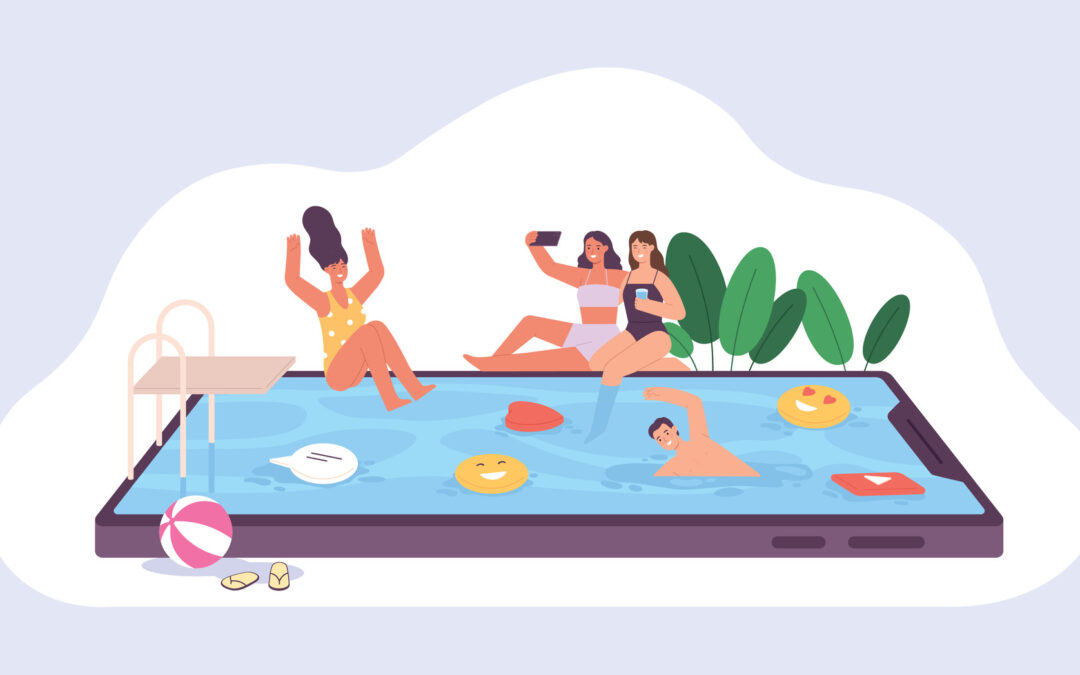
Here’s the thing about the version of people you see online: it’s edited. Not always in the “filter and Photoshop” sense, though sure, sometimes that too, but edited in the sense that someone chose that photo out of fifty, chose that caption, chose to post the good moment and quietly skip the twenty minutes before it where the toddler was having a meltdown or the “effortless” outfit took four tries. People show their highlights, not their whole reel [1]. Nobody’s out here posting the 2pm slump, the argument with their partner, or the fact that they also, definitely, at some point today, ate cereal standing over the sink.
That’s not necessarily people being fake or deceptive on purpose. It’s just… that’s what posting is. You wouldn’t hand someone your whole unedited camera roll either.
Your Brain Doesn’t Know the Difference, Though
Here’s where it gets tricky. Even though we logically know social media is curated, our brains don’t fully get the memo. Research on social comparison has found that people tend to judge their own lives against other people’s curated versions, not against their actual reality [1][2]. So you end up comparing your full, messy, complicated Tuesday to someone else’s best five seconds of their week. That’s not a fair fight, and it’s also not really a fair way to think about your own life.
Do this enough times, scrolling enough curated peaks, and it starts to quietly reshape what you think “normal” is supposed to look like [3]. Suddenly a totally average life feels like it’s falling short of some standard that, when you really think about it, doesn’t actually exist anywhere.
The Research Backs Up What You Already Suspected
This isn’t just a hunch. Studies have linked frequent social media use to lower self-esteem and more self-criticism, especially when people find themselves comparing their appearance, their success, or their life in general to what they’re seeing online [4]. And a lot of that comparison is happening against a moving target that was never fully real to begin with.
It’s Not Just Influencers, Either
It’s easy to assume this is only a problem with professional influencers who are, fair enough, literally paid to look aspirational. But it happens with regular people too. Your old coworker’s LinkedIn humble-brag. Your cousin’s “just a casual beach day” photo that clearly took forty takes. Even people who aren’t trying to sell you anything still tend to post their best angle, because, well, wouldn’t you?
So What Do You Actually Do With This?
Not “quit social media forever,” don’t worry, I’m not about to tell you to throw your phone in a lake. A few smaller things that actually help:
- Remind yourself, out loud if you have to, that you’re seeing a highlight, not the whole game. Just naming it takes some of its power away.
- Notice who makes you feel worse after you look at their page, and mute or unfollow. You don’t owe anyone your attention just because you follow them.
- Get curious about the gap. If someone’s life looks impossibly perfect, that’s often a sign of more editing, not less struggle. The people who share the messy, real, unfiltered stuff sometimes end up feeling far more relatable, and far less anxiety-inducing, to be around [5].
- Give yourself the same grace you’d give a friend. You’d never expect a friend’s life to look like a highlight reel 24/7. Extend that same logic to yourself.
The Bottom Line
What you’re seeing online was never the full picture, it was never meant to be. The kitchen wasn’t always spotless, the outfit took a few tries, the good mood didn’t last the whole day. Comparing your real, full life to someone else’s edited five seconds isn’t a fair comparison, and it was never supposed to be one. Give yourself some room to just be a regular, in-progress human. That’s what everyone else actually is too, whether their feed shows it or not.
I’m Jill Giuliano, LCSW. I’m a therapist practicing in my office in Westfield, New Jersey and virtually in New Jersey, Pennsylvania and Indiana, and social comparison and anxiety come up in my office constantly, way more than people expect. If this is something you’re struggling with, email me or call (908) 232-4044.
Read more on this topic: Managing Comparison on Social Media and How Social Media Feeds Your Anxiety
References
[1] Medium, Kashaf Iman. Social Media vs Reality: The Truth Behind the Filter. https://kashafmano.medium.com/social-media-vs-reality-0da77ab1d02f
[2] Cyberpanel. Why Stories Work Better for Real Moments Than Highlight Reels. https://cyberpanel.net/blog/why-stories-work-better-for-real-moments-than-highlight-reels
[3] SocialPlug. The Impact of Social Media’s Unrealistic Expectations. https://www.socialplug.io/blog/social-media-unrealistic-expectations
[4] SocialPlug. The Impact of Social Media’s Unrealistic Expectations. https://www.socialplug.io/blog/social-media-unrealistic-expectations
[5] Cyberpanel. Why Stories Work Better for Real Moments Than Highlight Reels. https://cyberpanel.net/blog/why-stories-work-better-for-real-moments-than-highlight-reels