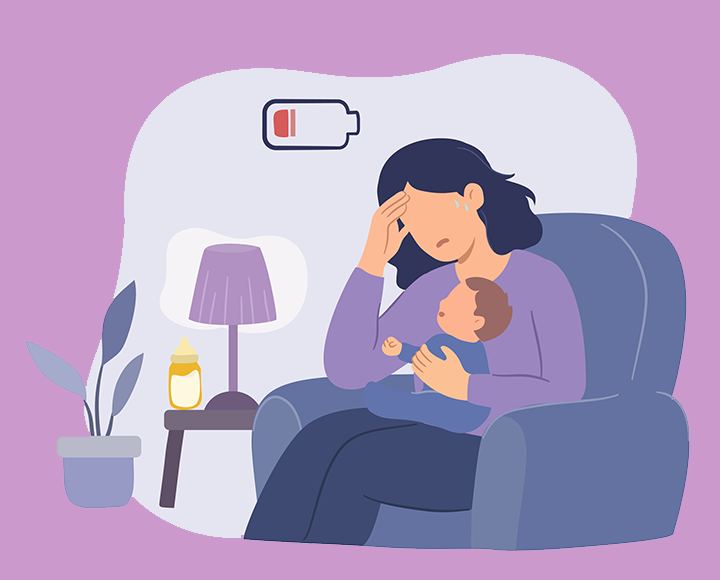
If you had a baby and someone asked how you’re doing, you probably said “tired,” because that’s the socially acceptable answer. But maybe what’s actually happening underneath is a lot louder than tired. Maybe you’re lying awake running through every possible way something could go wrong with the baby. Maybe you’ve checked that they’re breathing four times in the last hour. Maybe your brain won’t stop, even though nothing is technically wrong.
Here’s the thing a lot of new moms don’t realize: that’s not necessarily postpartum depression. It might be postpartum anxiety, and they’re not the same thing, even though most of the awareness campaigns, screening questions, and even well-meaning friends only ask about one of them.
We Talk About PPD a Lot. We Don’t Talk About PPA Nearly Enough
Postpartum depression has gotten a lot more airtime over the last decade, which is genuinely great. But postpartum anxiety is actually just as common, if not more so, and it flies under the radar constantly. One study found postnatal anxiety showed up in about 17% of new moms, compared to roughly 5% for postpartum depression alone [1]. Other estimates put PPA anywhere from 10% up to 20% [2]. Either way, this is not rare. If you’re dealing with it, you are extremely not alone, you’ve just maybe never heard anyone talk about it by name.
So What’s Actually Different?
Postpartum depression tends to look like the heaviness people expect: sadness, hopelessness, crying that doesn’t have an obvious trigger, feeling numb or disconnected from the baby, exhaustion that sleep doesn’t touch [3].
Postpartum anxiety looks different. It’s less “I feel nothing” and more “I feel everything, all at once, all the time.” Think racing thoughts, a body that won’t relax, constant what-ifs, irritability that seems to come out of nowhere, and a kind of hypervigilance where you’re essentially on guard duty 24/7, even when the baby is sleeping fine and nothing is actually wrong [4]. One way I’ve heard it described that I really like: postpartum depression is a feeling of being disconnected, and postpartum anxiety is a feeling of being too connected, like you can’t turn off the alarm system even for a second [4].
You might also be dealing with intrusive thoughts, sudden, unwanted, scary mental images or worries, often about something happening to the baby. These are incredibly common with postpartum anxiety and they do not mean you’re a danger to your child. They mean your brain’s threat detector is working overtime [5].
Can You Have Both?
Yes, actually, pretty often. A lot of moms with postpartum depression also have real anxiety symptoms layered on top, and researchers are still working out exactly how the two relate to each other [5]. In one study following women for six months after birth, nearly 20% of moms with depression also had significant anxiety, compared to just over 1% of moms without depression [5]. So it’s not always neat and separate. Sometimes it’s both, tangled together.
That said, plenty of women have anxiety with little to no depression at all, which is exactly why it’s worth knowing the difference. If you’ve only ever been screened for depression, and you’re the “everything is fine except my brain won’t stop” type rather than the “everything feels heavy and gray” type, you might get a clean bill of health on a depression screener while still very much struggling [2].
Why the Distinction Actually Matters
This isn’t just a semantics thing. It matters for what actually helps.
Depression tends to respond well to mood-focused therapy and, when appropriate, medication. Anxiety tends to respond especially well to approaches like CBT and mindfulness-based strategies that target the racing-thoughts, can’t-relax piece specifically [4]. If you’re only ever screened and treated for depression, the anxiety can get missed entirely, and you can walk away feeling like nobody actually addressed what you came in with [4].
What This Might Look Like Day to Day
- Constant worry about the baby’s health or safety that doesn’t ease up even when you’re told everything is fine
- A body that feels tense, wired, or unable to settle, even when the baby is asleep
- Irritability that feels out of character
- Racing or looping thoughts you can’t seem to shut off
- Trouble sleeping even when you have the chance to
- Intrusive, unwanted thoughts about something bad happening
If a lot of this sounds familiar, that’s worth naming out loud to your OB, midwife, or a therapist, specifically. Say the word “anxiety,” not just “I’m not doing great.” It genuinely changes what gets screened for.
One More Thing: This Can Show Up Later Than You’d Expect
Postpartum anxiety doesn’t always show up in the first two weeks. It can develop months in, sometimes well after everyone has stopped checking in on you and moved on to asking when the baby’s sleeping through the night [4]. If you felt okay at first and then this crept in later, that still counts. There’s no expiration date on “postpartum.”
I’m Jill Giuliano, LCSW. I’m a therapist practicing in my office in Westfield, New Jersey and virtually in New Jersey, Pennsylvania and Indiana, and I’ve worked with a lot of moms who spent months thinking something was wrong with them before anyone used the word “anxiety” out loud. It’s not a character flaw, and it’s genuinely treatable. If this sounds like you, email me or call (908) 232-4044, and we can talk about what support could look like.
Read more on this topic: Post Partum Depression or Baby Blues and Is Mom Anxiety Actually a Thing, or Is It Just Me?
References
[1] ScienceDirect. Postpartum Anxiety. https://www.sciencedirect.com/science/article/abs/pii/S1555415520304529
[2] Happiest Baby. What’s the Difference Between Postpartum Anxiety and Postpartum Depression? https://www.happiestbaby.com/blogs/parents/postpartum-anxiety-postpartum-depression
[3] Prisma Health. What are the differences between postpartum depression and postpartum anxiety? https://blog.prismahealth.org/what-are-the-differences-between-postpartum-depression-and-postpartum-anxiety/
[4] Counseling Today, American Counseling Association. Postpartum Anxiety vs. Postpartum Depression: Similarities and Differences. https://www.counseling.org/publications/counseling-today-magazine/blog/2026/02/24/postpartum-anxiety-vs.-postpartum-depression–similarities-and-differences
[5] MGH Center for Women’s Mental Health. Is It Postpartum Depression or Postpartum Anxiety? What’s The Difference? https://womensmentalhealth.org/posts/is-it-postpartum-depression-or-postpartum-anxiety-whats-the-difference/